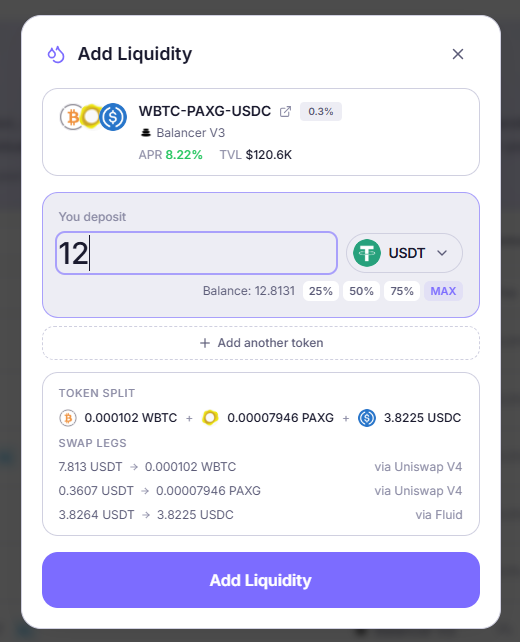
SwapWizard debuts directly across the five leading EVM networks, integrating in a single product two on-chain primitives: best-route token swaps across leading DEXes, and the ability to add or remove liquidity from a single token (or several) in a single atomic transaction, especially useful for concentrated liquidity positions.
Fragmentation is one of the silent costs of decentralized finance. To operate efficiently, sophisticated users find themselves switching between aggregator frontends for swaps, individual DEX frontends for liquidity positions, on-chain explorers to verify results, and portfolio tools to get an aggregated view. Each jump is friction, and each friction has a cost: in time, in errors, and in missed opportunities. The friction is especially acute for liquidity providers in concentrated positions.
DeFiRe Labs launches today SwapWizard, a DeFi execution layer that integrates swaps and liquidity operations as atomic on-chain transactions, and debuts directly across the five leading EVM networks: Ethereum, BNB Chain, Arbitrum, Base and Polygon. At launch, SwapWizard indexes approximately 2,500 liquidity pools with a minimum TVL of 5,000 USD across 10 AMMs. The TVL threshold is a deliberate filtering criterion: SwapWizard users do not encounter residual or abandoned pools cluttering the catalog.
SwapWizard did not emerge as a conceptual experiment or a speculative product. It was born out of a concrete operational need within the development of DeFiRe.finance, DeFiRe Labs' flagship project aimed at solving retail liquidity provider access. Optimized liquidity provision required routing swaps through the best available path across multiple DEXes, and the aggregator APIs available on the market charge fees of up to 0.3% per swap. Under DeFiRe.finance's economics, that cost was simply unsustainable. The alternative was to build the aggregator internally. Once the technical problem was solved, the consequent decision was to release the solution as open infrastructure so that any user or protocol could leverage it on equal terms.
Swaps with multi-DEX routing
When a user requests a token swap, SwapWizard's contracts query the available routes across supported DEXes on the active network and build the operation that returns the most tokens to the user. If the size of the operation is large enough that concentrating it in a single pool would generate adverse price impact, the contracts split the operation across multiple pools within the same transaction. The protocol fee is 0.1% (10 basis points), parameterized on-chain and verifiable directly from the contract. It is the only retention on the token flow: no spreads applied by the contracts, no fees for using the interface, no variable fees.
One deliberate protocol decision deserves a separate mention. When a price difference favorable to the user (so-called positive slippage) occurs between quotation and execution, that difference stays entirely in the user's wallet. SwapWizard's contracts do not retain it. This is one point where SwapWizard breaks with a practice that the research preceding its development identified as a de facto standard among leading routers: retaining positive slippage in favor of the router, with no transparency about it at the quotation stage. It is a practice reminiscent of the fine print of banking. SwapWizard considers that the favorable outcome of an execution belongs to the user who bears the risk of the operation, and its contracts are written accordingly.
Liquidity operations in a single atomic transaction
Providing liquidity in concentrated positions traditionally requires the user to calculate exact token proportions based on the range and the pool's current price, execute the necessary swaps to reach that proportion, approve the position manager, mint the position, and handle the residual dust. Five steps, multiple signatures, friction accumulated at each one. SwapWizard absorbs all of that complexity in a single atomic transaction. The user can add liquidity from a single token or from several tokens simultaneously. The smart contracts automatically calculate the exact proportion required by the range against the live pool state, execute the necessary swaps via the best available route, and create the position. All of it, within the same transaction: if any step fails, the operation reverts in full, with no intermediate states.
If any surplus remains after the contribution (almost inevitable, since swaps rarely produce millimeter-exact proportions), the contracts return it to the user within that same transaction, in the network's native token or in the contributed asset, as the case may be. No dust left behind in the wallet. The differentiation extends to classic AMMs (V2 and equivalents) as well: although classic contribution conceptually requires symmetric proportions, SwapWizard allows the user to do it from a single token, or to take the opportunity to contribute several residual tokens from the wallet and consolidate them into the position. The same logic that cleans dust at exit also serves to clean the wallet at entry. Liquidity removal works with the same simplicity: the user can exit to one or several tokens, which need not match those of the original LP.
An environment for exploring the AMM market
For each network, SwapWizard presents the catalog of indexed pools with sorting and filtering criteria designed to accompany the user's decision without replacing it. Pools can be sorted by APR, TVL or 24-hour volume in either direction, and filtered by protocol, by specific token, by pool type (concentrated or classic liquidity), and by composition (stable-only pairs, or pairs with at least one stablecoin). Combined criteria allow the user, once a filter is applied, to re-sort the resulting subset by any of the metrics above. This ergonomics is what turns SwapWizard, beyond an execution tool, into an environment for exploring the AMM market.
SwapWizard also provides actionable operational information during the flow. When the amount the user contributes to a pool produces significant price impact, the interface flags it visually; in cases of extreme impact, the option to continue is not enabled. For pools with hooks whose code or effects are not immediately evident, the interface highlights the circumstance so that the user can evaluate before contributing liquidity. Each pair displays a direct link to the frontend of the protocol where the user is a liquidity provider. These are aids to the user's own due diligence, not substitutes for it: the final decision on every operation belongs to whoever signs the transaction.
Unified execution and the cost of fragmentation
SwapWizard unifies the operational sequence in a single environment: the user executes swaps and, from the "My Positions" multi-DEX section, sees them aggregated by chain and can close them, all from the same interface and the same wallet. Liquidity operations incur no fees beyond the 0.1% on the internal swap required to rebalance proportions. The few protocols on the market that also simplify these operations charge fees of around 0.25% on the full operation, which significantly penalizes active liquidity management strategies. Support is also available from within the interface: the user connects their wallet and the communication channel with the team becomes available. No forms, no prior registration, no account, the same level of simplicity that runs through the rest of the operation.
A protocol designed for agents, not just for humans
SwapWizard exposes a public API for programmatic access to the protocol, with documentation available at swapwizard.xyz/api-docs. Bots, autonomous agents, third-party interfaces and custom clients can query routes, build transactions and operate against SwapWizard's smart contracts under the same on-chain conditions as any other user.
For autonomous AI agents, SwapWizard ships with a dedicated Model Context Protocol (MCP) server, published as open source at github.com/DeFiRe-business/swapwizard-mcp. Any agent compatible with the MCP standard can interact with the protocol without custom integration work. The agent connects, signs from its own wallet, and operates with the same primitives and conditions a human user would.
This is a deliberate design choice. SwapWizard is built on the premise that DeFi infrastructure should be equally accessible to humans operating through interfaces and to autonomous agents operating through programmatic access. As AI agents become a meaningful participant in on-chain activity, the protocols that make their integration trivial will compound usage faster than those that treat them as an afterthought.
"SwapWizard exists because we ran into the wall of aggregator fees and, with the sheer engineering skill of DeFiRe's CTO, Carlos Mayorga, we decided to climb over it rather than walk around it. What started as an internal solution turned out to be valuable enough to release as open infrastructure. What excites me is that we've removed a real layer of friction for anyone who wants to provide liquidity, especially in concentrated positions, without having to put themselves through the wringer to do it. That shouldn't require a five-step ritual; it should be one signature." — Mari Carmen Blanco, CEO of DeFiRe